
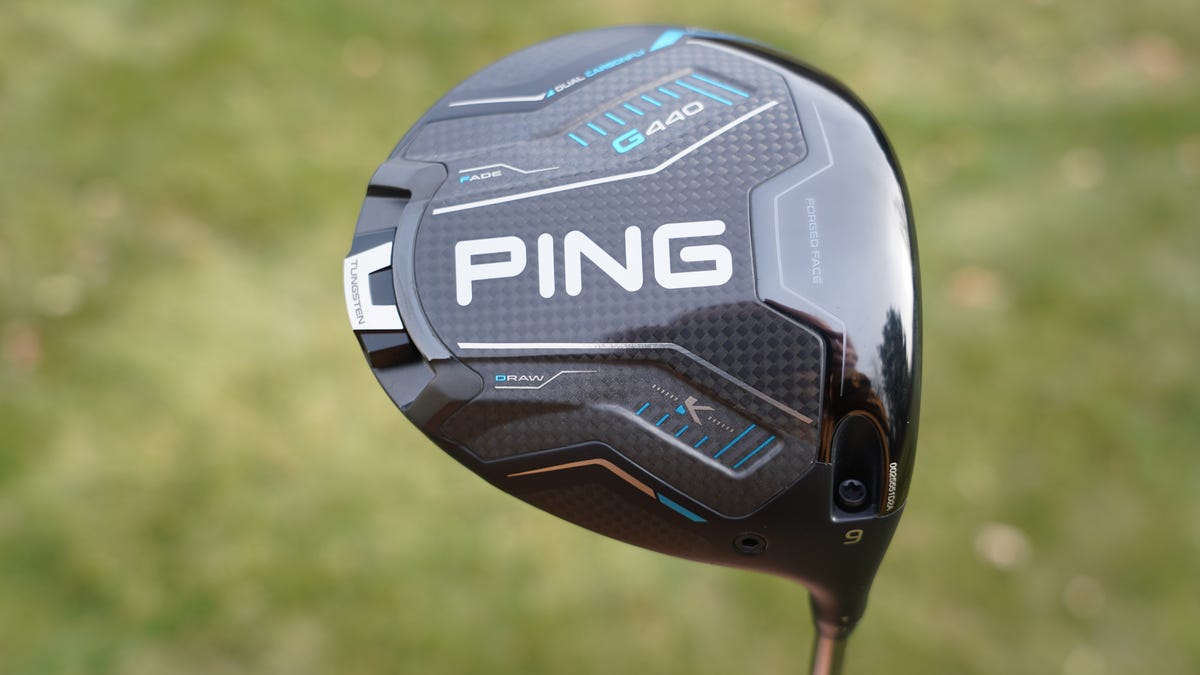
Ping’s G440K driver builds on the G430 Max 10K with dual carbon panels, a deeper CG, and the highest MOI in company history.
Gear: Ping G440K driver
Price: $705 with Ping Alta CB Black shaft and Golf Pride 360 Tour Velvet grip.
Specs: 460cc titanium head with carbon fiber panels on the crown and sole, forged T9S+ titanium face, 32-gram rear tungsten weight, and adjustable hosel. 9, 10.5 and 12 degree loft options.
Who it’s for: Golfers looking for Ping’s most stable and forgiving driver.
What you should know: The G440K builds on the success of the G430 Max 10K with a refined multi-material chassis, a slightly longer profile, and an even higher moment of inertia (MOI) designed to keep the clubface square through impact, launch the ball higher, and tighten dispersion without changing how golfers swing.
The Deep Dive: Ping’s history with stability dates back to the moment Karsten Solheim first moved mass to the perimeter of a putter in 1959. That same principle underlies the G440K driver, but the engineers at the brand’s Phoenix, Arizona, headquarters now have far more advanced materials and modeling tools than Solheim ever did in his garage.
The “K” in G440K signals Ping’s latest pursuit of the 10,000 g/cm² threshold. The company hit that milestone with the G430 Max 10K, a driver that instantly became one of the most forgiving models on the market. With the G440K, Ping pushed the concept further by rethinking how and where every gram of mass could be saved and reassigned.
Two carbon fiber panels — one on the crown that wraps around the top edges and another on the sole — form what Ping calls Dual Carbonfly Wrap. Each composite section saves about 3.5 grams compared with titanium. That redistributed mass, combined with a 32-gram adjustable tungsten weight in the back of the head, pulls the center of gravity lower and farther away from the face. The result is an MOI around 10,300 g/cm², roughly two percent higher than the G430 Max 10K and nearly 10 percent higher than the G440 Max. For golfers, that means less twisting on off-center strikes and straighter shots from tee to fairway.
The face is forged from Ping’s proprietary T9S+ titanium, a material strong enough to allow a thinner perimeter and a more flexible hitting area. The result is consistent ball speed across a larger portion of the face.
Inside, Ping redesigned the sound ribs and added a new I-beam-shaped carbon crown rib to tune acoustics while ensuring the head passes the USGA’s “finger test” for crown stiffness. The overall footprint is slightly longer from front to back, but the streamlined shape and deeper sole maintain aerodynamic efficiency.
Longer drivers can help golfers generate more clubhead speed, but they also tend to magnify off-center hits. Because the G440K is so stable and boasts such a high MOI, Ping decided it could extend the standard build length to the USGA limit of 46 inches without sacrificing dispersion.
In internal testing, Ping found the G440K produced about 4.5 yards more total distance and 0.8 mph higher ball speed than the G430 Max 10K, along with a 20 percent tighter dispersion pattern. Those gains may not sound dramatic, but for a company known for steady, data-driven evolution rather than radical reinvention, they’re significant.
The G440K will be available in 9-, 10.5-, and 12-degree lofts, with a 7.5-degree Tour-only head circulating among staff players. For golfers who need more help launching the ball, Ping will offer a High Launch (HL) version with a lighter back weight, ultra-light shaft, and smaller grip to promote more clubhead speed and easier carry distance.
The G440K feels like the culmination of Ping’s decades-long MOI chase — a driver that doesn’t force players to choose between speed, forgiveness and sound. It isn’t flashy, but like the G-series lineage that came before it, this one is built to deliver what matters most: more consistency, more confidence and a few extra fairways even when the strike isn’t perfect.