
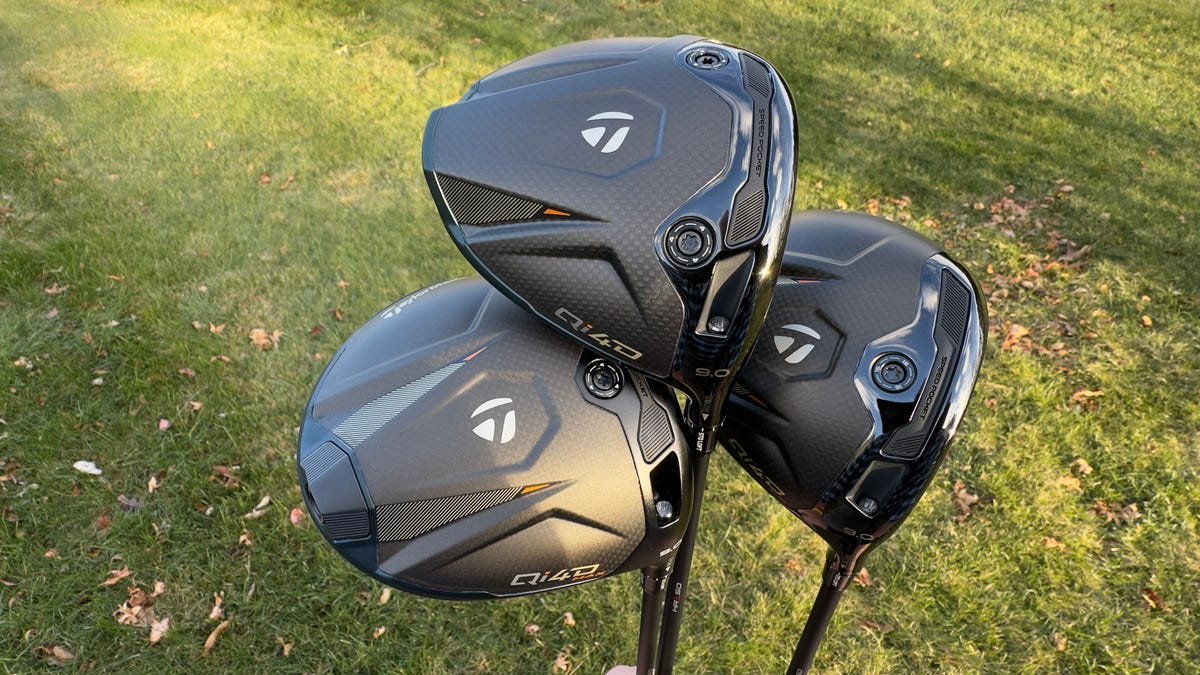
TaylorMade’s Qi4D drivers break speed into four dimensions, pairing carbon faces, adjustable weighting and stock shafts built to fit more swings.
Gear: TaylorMade Qi4D, Qi4D LS, Qi4D Max drivers
Price: $649 with Mitsubishi Reax shaft and Golf Pride Z Grip +2; $699.99 with reflective fitter markings
Specs: Titanium chassis with carbon face, crown and sole panels, moveable weights and adjustable hosel
Available: Jan. 29
Who it’s for: Golfers seeking more consistent ball speed and tighter spin windows.
What you should know: TaylorMade rebuilt its driver platform around four dimensions of performance: face behavior, aerodynamics, shaft response and center-of-gravity adjustability. The goal is to deliver a more predictable launch and spin for a wider variety of swings.
The Deep Dive: As they were developing the Qi4D driver line, TaylorMade’s designers and engineers broke the concept of speed into four dimensions, focusing on the face, the shape of the head, the shaft, and the adjustability features that help ensure a proper fit. If those elements could be dialed in, they believed they could produce a driver that would work for a wide range of golfers. That included staff players like Rory McIlroy, Nelly Korda, and Scottie Scheffler, as well as recreational golfers.
Now you know what the name Qi4D stands for: four dimensions of speed. While the standard Qi4D, the low-spin Qi4D LS and the forgiveness-minded Qi4D Max all share several core technologies, they are designed for very different types of players.
All three models feature large carbon fiber crowns and sole panels, along with adjustable hosels that allow golfers to increase or decrease loft by up to 2 degrees. Each model also features a carbon fiber face. This technology first appeared in TaylorMade’s Stealth drivers in 2022. But for Qi4D, TaylorMade refined the face by tightening manufacturing tolerances so the faces sit closer to the USGA and R&A limits on coefficient of restitution (COR) and characteristic time (CT). The more precisely TaylorMade can control the hitting area, the more consistently it can increase ball speed without risking non-conforming heads.
TaylorMade also revised the face curvature from top to bottom, known as roll. Typically, shots hit high on the face launch higher with less spin, and low-face strikes launch lower with excessive spin. By rounding the roll radius, Qi4D drivers add spin to high-face strikes and reduce spin on low-face strikes, normalizing spin across a larger portion of the hitting area for more consistency.
Although custom fitting is growing, most golfers still buy stock-shaft drivers, so offering stock shafts that could better match what most golfers need to produce high-quality strikes was another priority for TaylorMade.
After studying more than 11,000 swings from staff professionals and recreational players, the brand’s fitters identified correlations between a golfer’s release patterns and the shaft they ended up using.
TaylorMade grouped players into three categories: high rotation (HR), medium rotation (MR), and low rotation (LR). Specific shaft designs consistently matched each group’s delivery patterns. Then it partnered with Mitsubishi Chemical to create three updated Reax shafts — Red, Blue and White — that matched those patterns. Red has a softer tip for HR players, White has a stiffer tip for LR players, and Blue sits in the middle for MR players.
With these shafts in place, TaylorMade intends for fitters to use the head, loft and moveable weights to produce the ball flight a player wants, while the shaft helps the golfer deliver the club more consistently.
Finally, but offering three different Qi4D drivers, TaylorMade felt nearly every player should be able to find a combination of head style, loft, shaft and adjustable features to maximize their swing.
The standard Qi4D (9, 10.5 and 12 degrees; 8-degree RH only) includes two 4-gram weights in the front heel and toe ports and two 9-gram weights in the rear ports. Fitters can configure those cartridges to create strong draw, strong fade, subtle draw or subtle fade biases. Putting both heavy weights forward lowers launch and spin while increasing speed. Placing both heavy weights in the back maximizes forgiveness and stability. The head is 4 millimeters shorter from front to back than the Qi35, but TaylorMade says it is more aerodynamic and produces about 1.2 mph more ball speed.
The Qi4D Max (9, 10.5 and 12 degrees) is the most stable and most forgiving driver in the lineup for players who struggle with inconsistent strikes. Instead of using titanium in the ring that forms the head frame, designers saved weight by using forged aluminum, which is then milled into the final structure that holds the carbon face, crown, and sole. The Max has two moveable weights, a 4-gram and a 13-gram, positioned in the front and back of the sole. The head has a built-in draw bias and less left-right adjustability than the standard Qi4D. With the 13-gram weight in the back, the moment of inertia increases significantly. The combined MOI is about 9,700 g/cm2. That does not meet the technical threshold to be labeled a 10K driver, but the Qi4D Max is TaylorMade’s first ultra-high-MOI driver with an adjustable hosel.
TaylorMade will also offer a Qi4D Lite (10.5 and 12 degrees), which is 30 grams lighter than the standard Qi4D Max and designed for golfers with slow-to-moderate clubhead speed.
The Qi4D LS (9 and 10.5 degrees; 8 degrees RH only) is the lowest-spinning and lowest-launch model. It remains a 460cc head but has a more rounded profile. The crown sits higher behind the topline and the back of the sole rises more sharply, which creates the most aerodynamic shape in the Qi4D line. The LS includes 4-gram and 15-gram weights so players and fitters can adjust launch and spin.
TaylorMade is also making its reflective fitting heads available to consumers. These heads were previously limited to fitters only. They are legal for play and allow golfers with access to Foresight launch monitors to collect clubhead data along with ball data.